Install A Heat Pump Water Heater
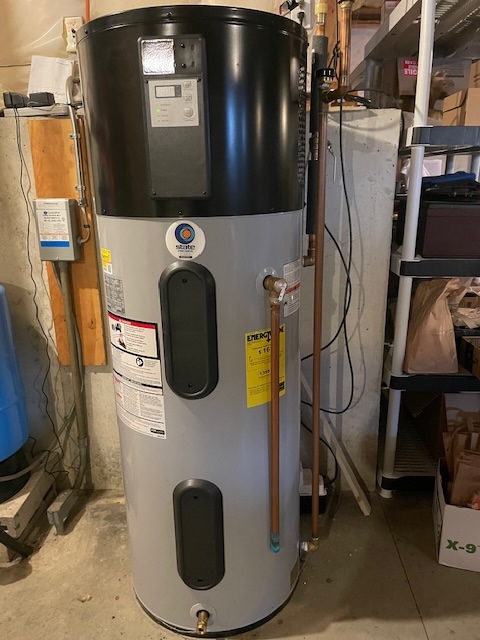
Summary: Using a heat pump hot water heater provides hot water at efficient cost.
Description
Heat Pump Water Heaters (HP WH) – also known as ‘hybrid’ hot water heaters - use an electric heat pump to move heat from air into the hot water tank. If you now use electricity or a fuel such as oil or gas to make heat to make hot water, the efficiency is limited to about 98% for electricity and about 60%-95% for oil or gas. A typical HP WH will typically have an efficiency of about 250% to 400%.
Deep Dive
How does a heat pump water heater work?
It is important to understand that a HP WH moves heat from the air into a hot water tank, and after the hot water is used that heat ‘leaves the building’ by going down the drain, so the net effect is to cool the air. While there are so called ‘split’ HP WH which have an outdoor unit which takes heat from outdoor air and moves it to an indoor tank, this discussion will focus only on ‘single unit’ HP WH, which are typically a cylindrical insulated tank atop which there is a small heat pump compressor and fan which is used to remove heat from the air surrounding the tank, using it to heat the water in the tank.
An interesting side effect is this process also provides some dehumidification. The combination of the cooling and dehumidification effects of the air suggest that the best location for a HP WH is in a basement, where some cooling of the air is not objectionable, and where the dehumidification is likely to be most welcome. If you have a basement dehumidifier, installing a HP WH will likely reduce the amount of time the dehumidifier runs, and in some cases of greater hot water use, may eliminate operation of the dehumidifier entirely. This can be a significant energy savings in itself. Another point to note, a HP WH moves air through a cooling coil using a fan, so it makes some noise, comparable to a window air conditioning unit, another reason the basement is a good location.
NOTE: Some HP WH have optional leak detection, which will shut off the inlet water to minimize water leakage damage in the event of a leak in the tank. Some have a WiFi interface so you can ‘check in’ to see if there is any issue when you are away from home, and may enable participation in future utility company's "Demand Response" programs to save more money.
What are the Efficiency of Heat Pump Water Heaters?
Efficiency and Savings - A traditional electric resistance hot water heater uses electricity to directly heat water, with an efficiency of about 98%, meaning practically all the electricity that goes into a traditional electric resistance hot water tank heats the water. While some HP WH have a measured efficiency (now known as Uniform Efficiency Factor or UEF) of up to 400%, as a practical matter, when a HP WH is installed in a typical unheated basement, measured results indicate an efficiency of about 250%, which is still impressive. In a typical home, heating hot water can be approximately 15% of the total energy use of a home, so switching to a HP WH can produce considerable savings, as well as a substantial GHG emissions reduction.
What are the Savings using a Heat Pump Water Heater/
If you currently make hot water with oil or propane, a HP WH may save 50% when compared to oil or propane. Switching from methane gas it will probably be closer to break even. And using super clean, very inexpensive Hudson Light and Power electricity, you can feel good about saving money! Efficiency Maine has an online calculator so you can see how much you can save: https://www.efficiencymaine.com/at-home/water-heating-cost-comparison/?
Why would I want to replace my hot water heater?
There are a number of reasons you might want to replace your existing hot water heater with a HP WH. Your existing electric resistance, or gas or oil fired tank may be near end of life, and you don't want to wait until it fails to do an ‘emergency’ replacement. Or you may have installed heat pumps to heat your home, and no longer need the fossil fuel heating system to operate, except for the fact it also heats your hot water. You may be unhappy with the amount and consistency of hot water you receive.
What type of heat pump water heater should I get? What should I know about installing it?
The most popular HP WH use 240 V, so it takes two circuit breaker positions in your electrical panel. These typically have two 4500 watt electric resistance elements (just like a conventional electric resistance tank) that can be used in the event the HP can’t heat water fast enough for very long hot water draws. Or in the event the HP fails, you can simply switch over to the electric resistance elements so you have plenty of hot water until the HP is repaired. Or, in a very cold winter situation, you might find your basement is getting colder then you like, so you can switch off the HP and let the electric resistance elements heat your water for a month or two, then switch back to the HP mode during the warmer months so you can save on your electricity bill, as well as dehumidifying your basement.
It is best to choose a HP WH tank size that is sufficiently large so you hardly ever need to use the electric resistance heating, because that is most efficient operating mode. The HP in the HP WH takes more time to heat water because it does so more efficiently. If you have an existing 40 gal water tank, you could upgrade to a 55 HP WH, if you have a 50 gal water tank you could upgrade to a 65 gal., and most HP WH are also available with an 80 gal tank.
There is a newer 120 V HP WH that just plugs into a regular wall outlet, which has no electric resistance elements, so it only operates in heat pump mode. This means if the HP fails, it can’t make hot water till it is repaired. It also means if you have a very large use of hot water, it may take 3-4 hours to heat the cold water that replaces it.
Still, the 120 V HP WH can be attractive in some situations, they may cost less, there may not be space available in the circuit panel for two more circuit breakers for a 120 VAC HP WH, but there is a convenient 120 V outlet available. One possible hedge is to get a larger 120 V HP WH – for example, if you were going to replace a 50 gal tank, get the next size up (e.g. 65 gal) 120 V HP WH. When considering tank size, you can obtain the ‘first hour rating’ which is the maximum amount of hot water that any water heater can supply in a sustained 60 minute draw. One downside of the 120 V HP WH is considerably lower efficiency. To be ENERGY STAR certified, a 240 V HP WH must have a minimum 3.3 UEF, and a 120 V must have a minimum 2.2 UEF. So the 120 V HP WH is perhaps an option that is best avoided, unless it is really necessary.
A HP WH runs for longer periods of time slowly filling the water tank with heat, this is not a problem, that’s just the way they work best.
The Heat Smart Alliance https://heatsmartalliance.org/ is a volunteer group working to displace the use of fossil fuels to heat homes and hot water by the use of heat pumps, and they have an excellent, very detailed whitepaper on HP WH you can download:
This is a video that briefly describes how a HP WH works and illustrates the simple case of replacing an existing electric resistance water heater – simple because the electrical wiring is simply reused. If you have an oil or gas water heater an electrician would have to install that wiring: https://youtu.be/YeMqq5T2dCQ
Here is the experience of someone who replaced their electric resistance tank with a HP WH:
https://goclean.masscec.com/customer-story/tonys-heat-pump-water-heater/
The Green Energy Consumers Alliance had an informative and detailed webinar on HP WH on 3/26/2024: https://www.youtube.com/watch?v=PhVogWjxkwk
If you have an existing electric resistance tank, it is very likely you can re-use the existing wiring for a HP WH, as it has a pair of 30 amp circuit breakers. If you have oil or gas water heating now, you will need the services of an electrician to run the wire, unless you opt for the 120 V HP WH described above. Something else to consider if you were thinking about waiting until you existing tank fails to do an ‘emergency’ replacement.
Many HP WH have a 10 year warranty, be sure to ask for warranty coverage details.
Since HP WH move air though them to acquire heat from the air, they have a simple washable filter that should be kept clean, check every month until you have a better idea of how often you need to clean it, be sure to keep it clean for the best efficiency.
Mass Clean Energy Center – Clean Energy Lives Here – HP WH overview
https://goclean.masscec.com/clean-energy-solutions/heat-pump-water-heater/
Steps to Take
Step 1: Assess your current water heater, how much life do you think is left? Typical conventional water heaters may have a 10-12 year lifetime. Would you rather wait till it fails before you replace it, or would you like to upgrade to a Heat Pump Water Heater before then? If you want to wait till it fails to replace it, do your shopping now, and review the other steps below so you know exactly what to do when it fails.
Step 2: Get at least two quotes from local installers, you can use a plumber or a full service HVAC installer you know already, or use one of the links below to find an installer who is ideally familiar with HP WH, and who can repair it, should that become necessary:
https://goclean.masscec.com/installers/
https://www.energystar.gov/productfinder/water-heater-installers-by-state/MA
Step 3: Understand the requirements for HP WH incentives.
According to the ENERGY STAR website you can claim a tax credit of up to 30% of project cost, up to a maximum of $2000, for installing a HP WH. Here is a tool to help you find eligible ENERGY STAR HP WH:
https://www.energystar.gov/about/federal-tax-credits/heat-pump-water-heaters
Rewiring America has additional information on HP WH tax credits:
https://homes.rewiringamerica.org/federal-incentives/25c-heat-pump-water-heater-tax-credits
Hudson Light and Power offers up to a $750 rebate for eligible ENERGY STAR HP WH:
https://www.hudsonlight.com/rebates
Hudson Light and power also offers a lower Rate 6 for homes with an electric water heater:
https://www.hudsonlight.com/residential
If you do not have two spare circuit breaker positions for a HP WH in your electrical panel, you may be able to add a subpanel, and if that is done in the same year as adding the HP WH, you may be able to claim up to a $600 tax credit see:
https://www.energystar.gov/about/federal-tax-credits/electric-panel-upgrade
See the Deep Dive for more information.
- All Actions