Use Rain Barrels for Outdoor Watering
Summary: Save water by using rain barrels.
Description
In summer months, about 40% of household water is used for watering lawns and gardens and other outside uses. With seasonal droughts, and accompanying restrictions and bans on lawn watering, it makes sense to use rainwater instead of well water these purposes.
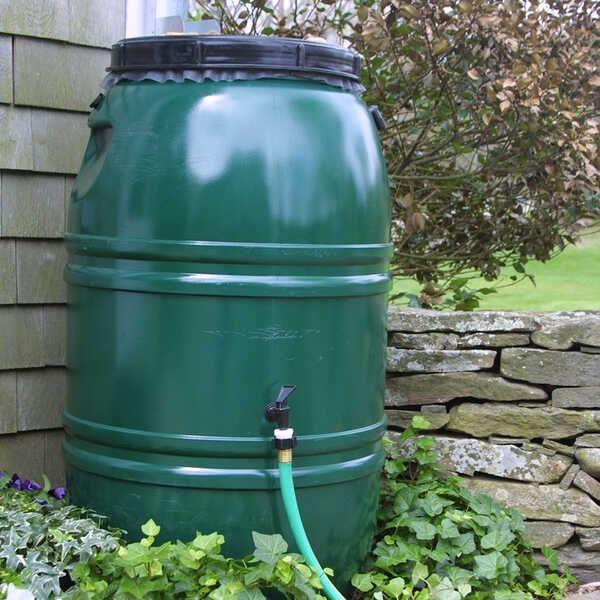
Rain barrels capture rainwater from your roof and store it for future use. Water is diverted from your home’s downspout or gutter into a rain barrel during rainstorms. This free water can be stored for use during times of less rain or drought; helping lower water runoff from your property, and reducing demands on wells. While rainwater is a healthy, chlorine and chemical-free water source for plants and gardens, the water in a rain barrel should not be used for drinking.
Rain barrels connect to a downspout or gutter with a diverter, from which water is directed through a hose into the barrel. A garden hose can be attached to a spigot near the bottom of the barrel for watering. Multiple barrels can also be linked together via hoses to provide more water storage.
Rain barrels and the necessary fixtures for hooking them up can be purchased from various companies. You can also make your own rain barrels and build covers for them, so they are more aesthetically pleasing. For more information on this, check out the Deep Dive section.
See the Steps You Can Take and the Deep Dive sections for more on installing rain barrels.
Deep Dive
Rising climate temperatures are intensifying the water cycle, making wet periods wetter and dry periods drier. Precipitation is highly variable but overall it has increased in Massachusetts over the last century. However, the drought periods increase the chance of water restrictions. You can see graphs of Massachusetts precipitation here: https://statesummaries.ncics.org/chapter/ma/
When heavy rain falls over drought-stricken soil, it often can’t soak into the ground and becomes runoff. This can impact crops, gardens, yards, wildlife, and residents’ local wells and fire cisterns, in both water levels and water quality.
You can purchase rain barrels and the necessary attachments from many vendors, which you can find online. Also check out local town or climate organizations’ websites to see if they are running a local barrel program, which might offer rain barrels at a fee less than buying them in a store.
To learn more about rain barrels and other water conservation tools, go here:
https://www.mass.gov/guides/rain-barrels-and-other-water-conservation-tools
To make your own rain barrel, check out these sites:
https://www.bhg.com/gardening/design/projects/how-to-make-rain-barrel/
https://www.youtube.com/watch?v=g0y0BmEFUcs
For information on the world water crises, go here:
https://www.growingblue.com/water-in-2050/
Steps to Take
Step 1. Before purchasing a rain barrel, assess your outdoor water needs. Do you need water for your yard, a garden, or other uses such as washing your car, windows, etc.? How much water do you use outside per month?
Step 2. Decide whether you want to purchase a rain barrel or make one. See the Deep Dive section for a link to a video on making your own rain barrel.
Step 3. Locate an area to place the rain barrel. Most people choose to place it along a side or back of their house, near a downspout. Measure your rain barrel and ensure the barrel will comfortably fit in the site you choose. Include an extra foot or two at the bottom of the barrel for a base the barrel can sit on to help water flow into a garden hose.
Step 4. Follow the directions provided by your rain barrel vendor for installing the barrel or check out some of the sites mentioned in the Deep Dive for parts you will need to make and connect up your own rain barrel.
Step 5. If your rain barrel has a cover with a raised lip, set small rocks on it and add a small amount of water. The rocks provide perches so thirsty birds can drink the water on the lid.
- All Actions